 Current
location:
Current
location: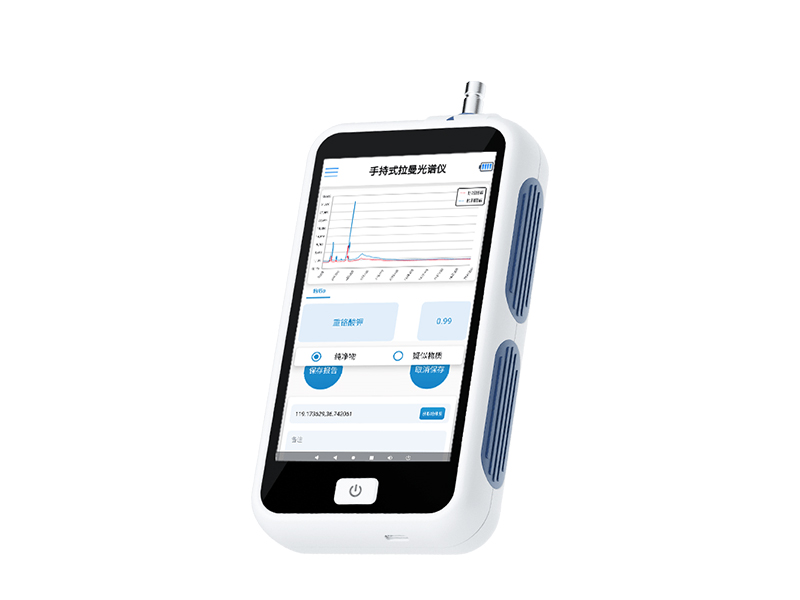
Product Overview
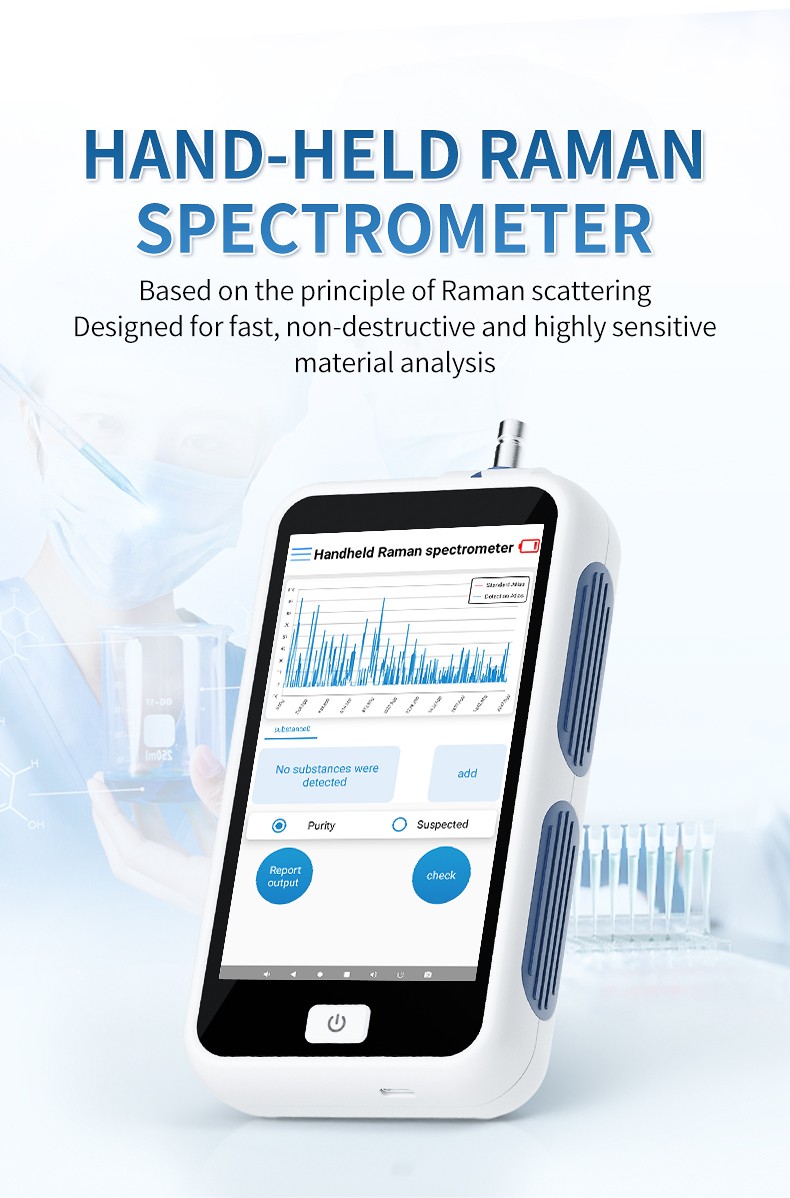
The HM Instruments HM-SLM Handheld Raman Spectrometer is a portable miniature confocal Raman instrument built to answer a specific field question: what is this material, and can we confirm it here, without opening the container or sending a sample to the laboratory? Because it probes molecular vibrations through Raman scattering, the HM-SLM produces a fingerprint spectrum that identifies a substance in a non-destructive way, and its 785 nm excitation and confocal optics are chosen to reduce fluorescence interference from real-world samples and packaging.
At about 750 g with the battery and rated IP67, the instrument is designed for the sample's own environment — goods-in areas, production floors, inspection points and outdoor sites — rather than a fixed bench. Its built-in standard spectral library covers a broad range of substances, and operators can extend it with reference spectra of their own materials so that identification keeps pace with the materials a site actually handles.
Key Features
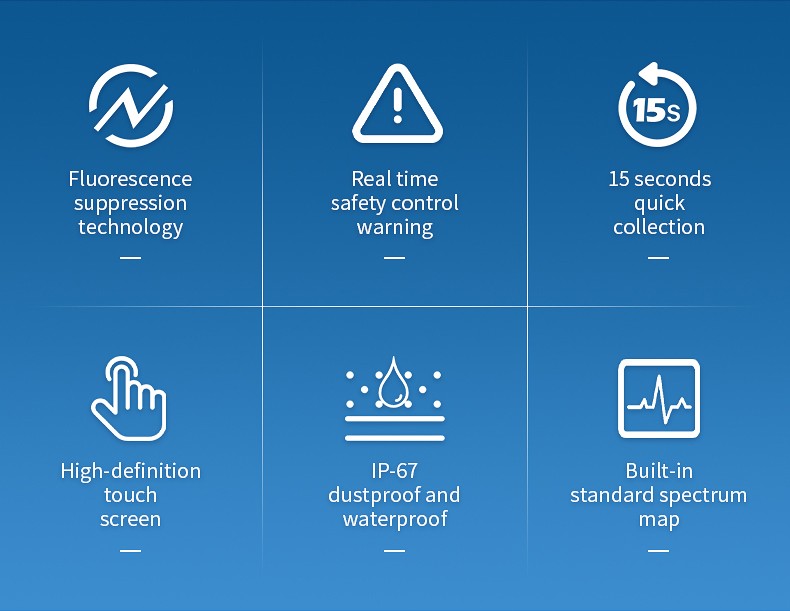
- Field-ready by design: Roughly 750 g including the battery, IP67 dust and water protection and a 5.5-inch HD touchscreen let the instrument be carried to the sample and used where the work happens.
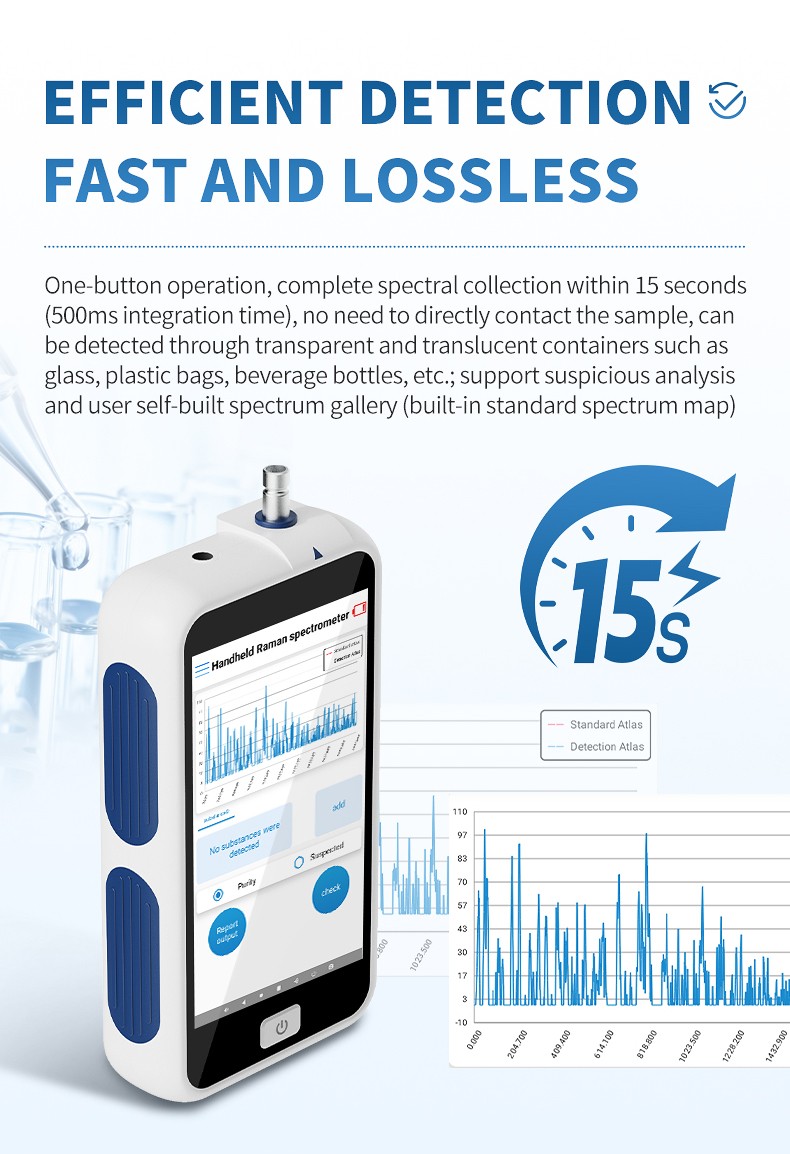
- Measurement through the container: Samples can often be measured through glass, plastic bags and beverage bottles without contact or opening, which suits incoming inspection and screening points where keeping packaging intact matters.
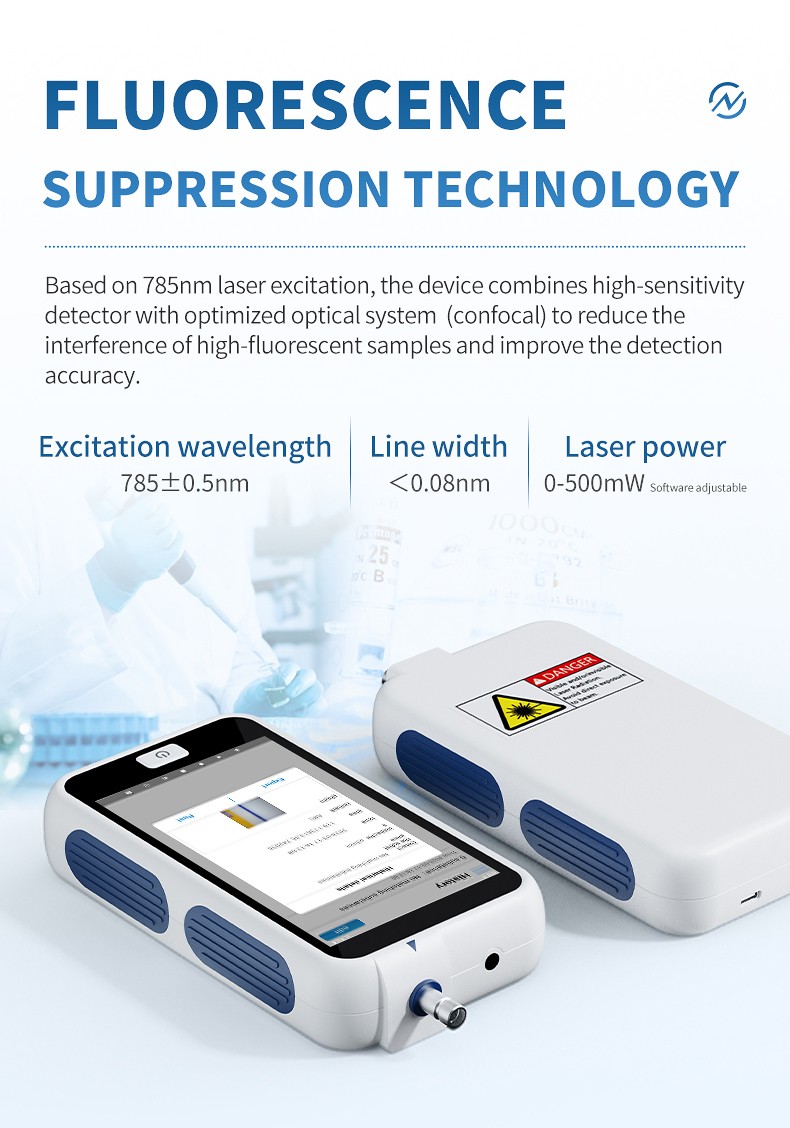
- 785 nm fluorescence suppression: 785 ± 0.5 nm excitation with a linewidth below 0.08 nm, paired with a high-sensitivity detector and optimized confocal optics, reduces interference from high-fluorescence samples and packaging.
- Fast results: One-button operation collects a spectrum at the standard 500 ms integration time and typically returns a matched result within about 15 seconds.
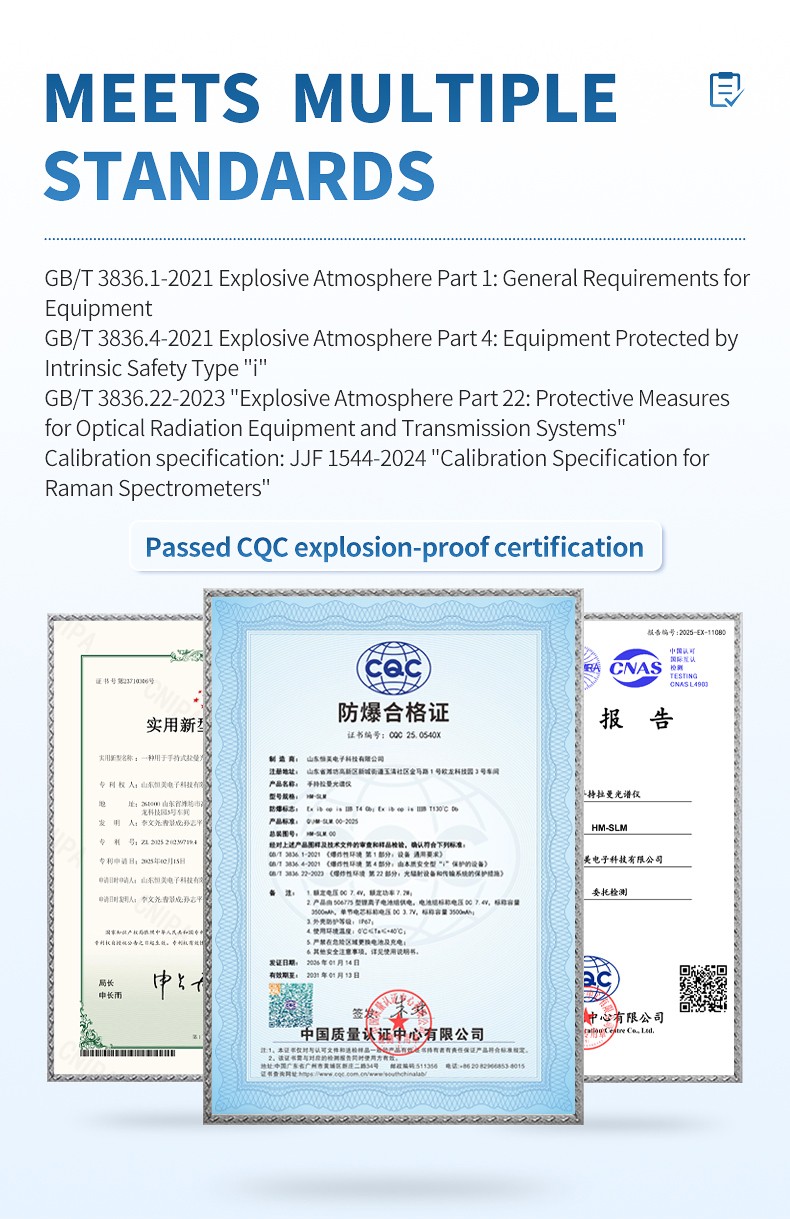
- Explosion-proof certified: CQC explosion-proof certification with the marking Ex ib op is IIB T4 Gb and Ex ib op is IIIB T130℃ Db, complying with GB/T 3836.1-2021, GB/T 3836.4-2021 and GB/T 3836.22-2023 — relevant where solvent vapours may be present.
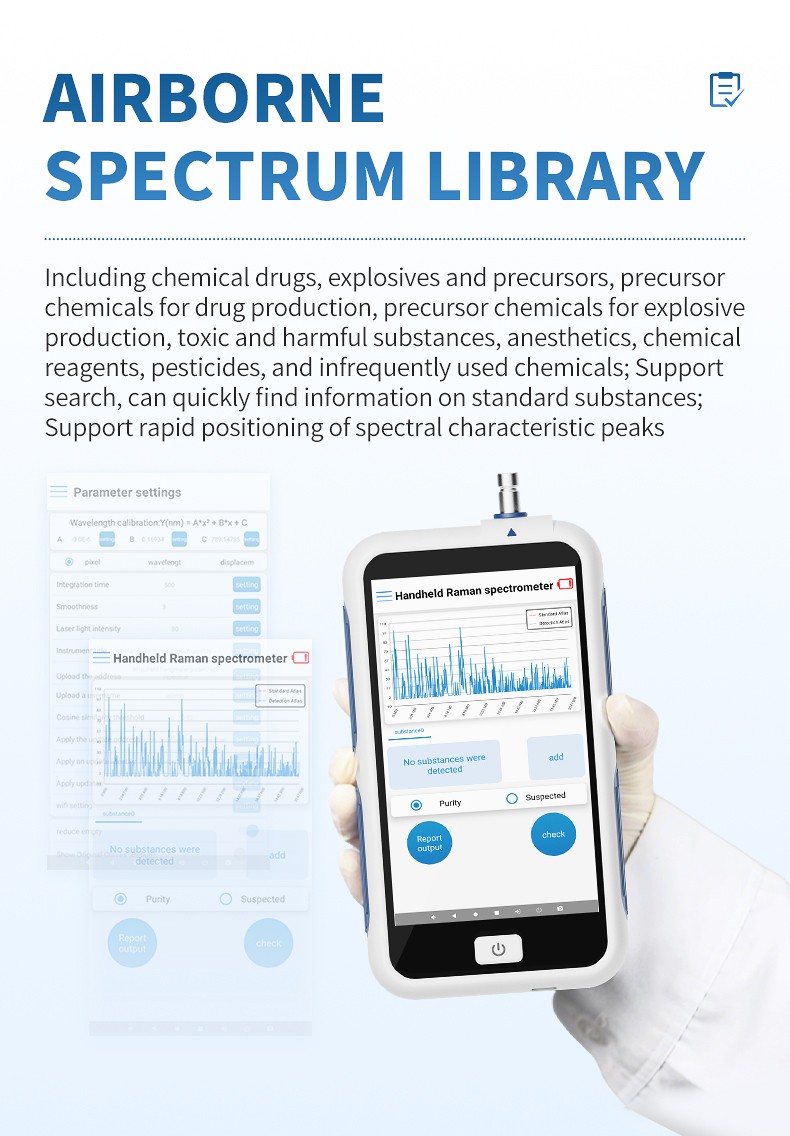
- Broad on-board library: Chemical drugs, explosives and precursors, precursor chemicals for drug and explosive production, toxic and harmful substances, anesthetics, chemical reagents, pesticides and infrequently used chemicals, with search and rapid characteristic-peak positioning.
- Site-specific libraries: Operators add reference spectra for their own materials; new entries can be reviewed and promoted to the standard library by an administrator through the network account.
- Cloud architecture and private deployment: A cloud service supports wireless upload of measurement data for short- and long-term analysis, cloud-based model updates, and cloud data search and identification; for sites that need to keep data on their own infrastructure, the platform can be deployed privately with the existing database supplied.
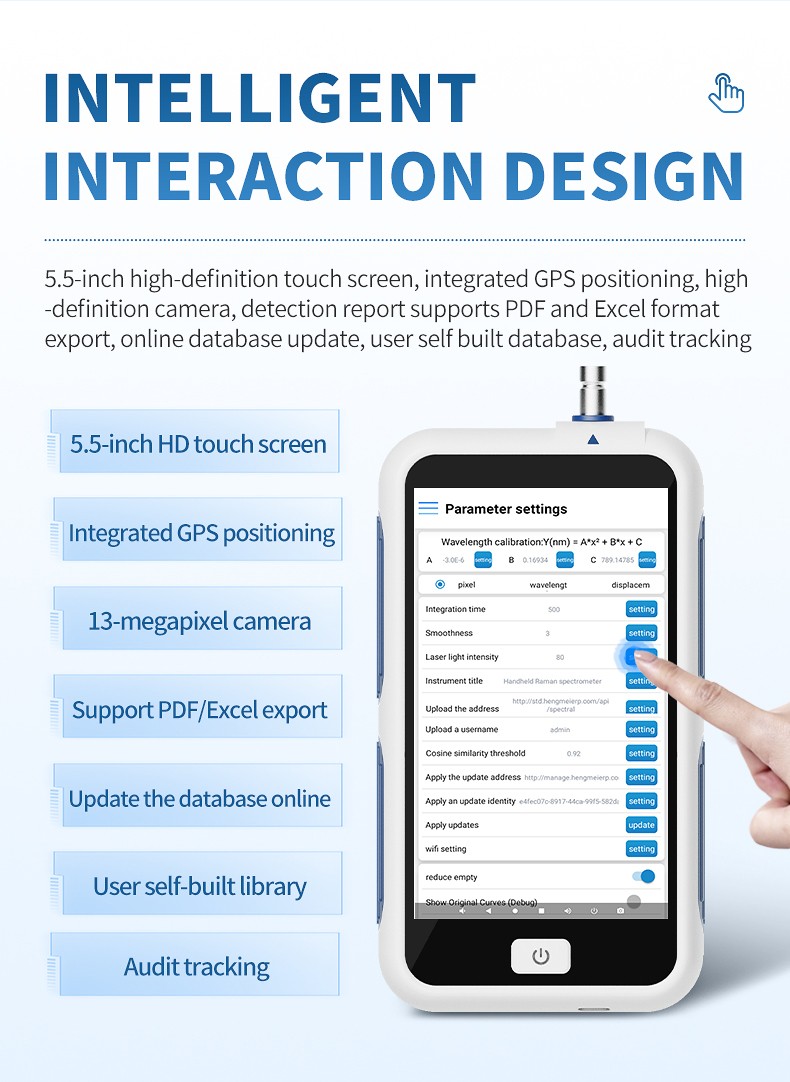
- Traceable records: Android 12, integrated GPS, a 13-megapixel camera, PDF and Excel export, online database update and audit tracking support defensible field documentation.
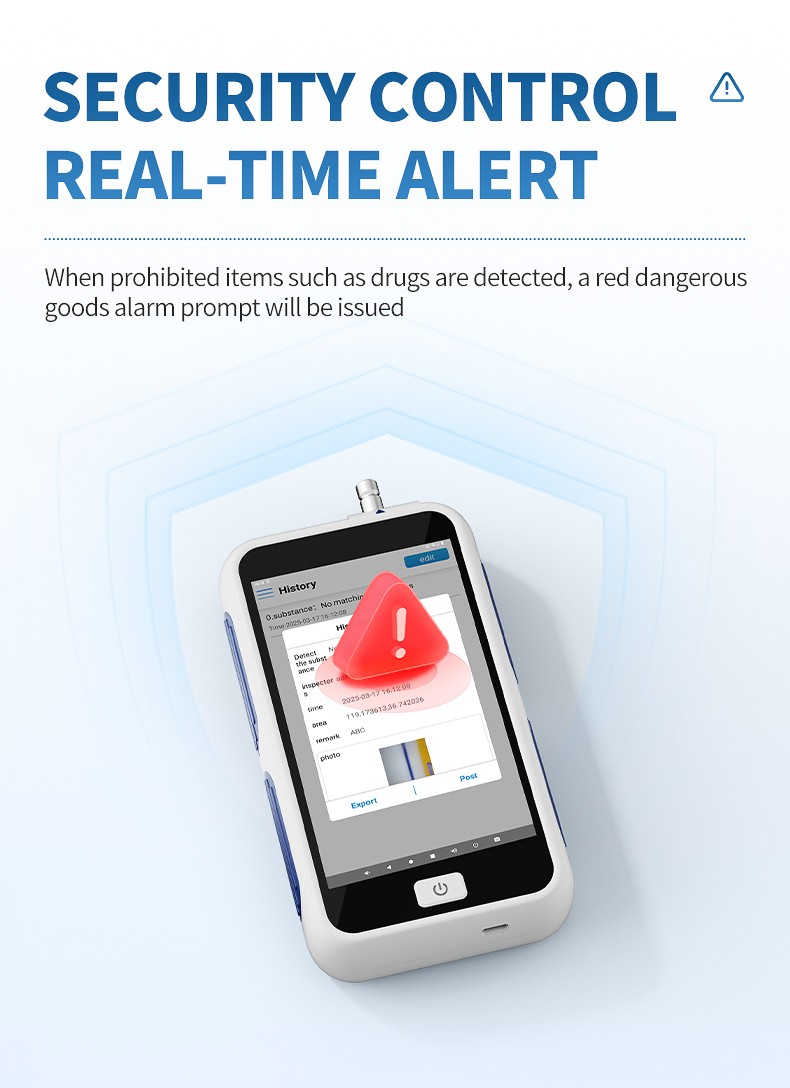
- Real-time alert: A red dangerous-goods alarm prompt appears on screen when prohibited substances such as drugs are detected.
Applications
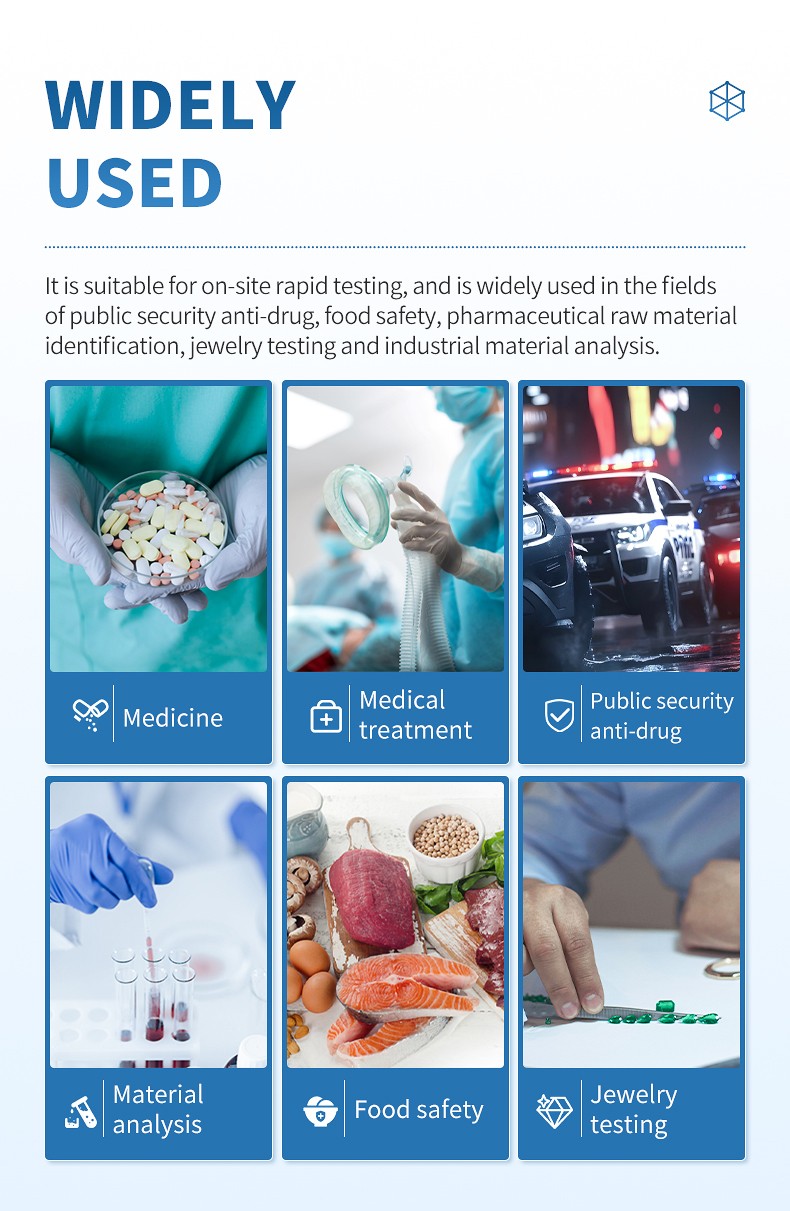
The HM-SLM supports on-site rapid testing across the following fields and tasks:
- Pharmaceutical raw material identification: incoming material identity checks at goods receipt, often performed through transparent or semi-transparent packaging before full laboratory testing.
- Public security and anti-drug work: rapid field identification of suspected substances and precursors, with the built-in library and real-time alert supporting screening decisions.
- Food safety: rapid, non-destructive screening of food and agricultural materials at inspection points.
- Chemicals detection: rapid identification of chemical substances and reagents where a portable, non-destructive check is required at the point of use.
- Jewelry testing: non-destructive identification of gemstones and related materials.
- Industrial material analysis: incoming and process material identification where a portable instrument is needed on the floor.
Choosing where Raman fits: The technique is strongest for crystalline organic solids, many solvents and materials with strong, well-defined vibrational modes. It is less effective for highly fluorescent samples, dark or strongly absorbing materials, and very dilute aqueous solutions where the analyte signal is weak relative to water. Packaging is part of the decision: thin transparent plastic and clear glass usually allow measurement through the container, while thick amber glass, opaque drums and metallised foil do not, and a quartz container should be used instead. Treating Raman identification as a rapid preliminary check, with full laboratory testing retained where required, keeps expectations aligned with what the method can support.
Technical Specifications
| Parameter | Specification |
|---|---|
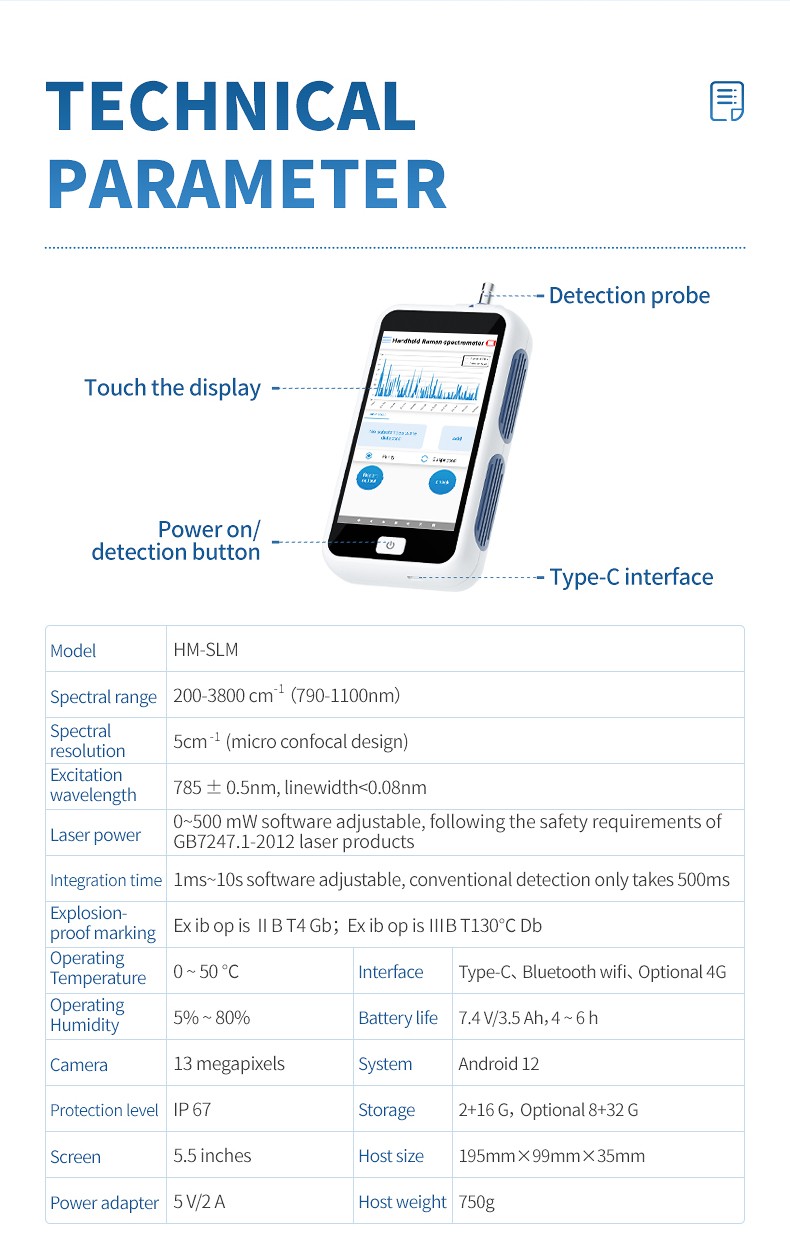
| Model | HM-SLM |
| Analytical principle | Raman scattering; miniature confocal design |
| Spectral range | 200 - 3800 cm⁻¹ (790 - 1100 nm) |
| Spectral resolution | 5 cm⁻¹ (micro confocal design) |
| Excitation wavelength | 785 ± 0.5 nm, linewidth < 0.08 nm |
| Laser power | 0 - 500 mW, software adjustable (in accordance with the laser product safety requirements of GB 7247.1-2012) |
| Integration time | 1 ms - 10 s, software adjustable; 500 ms typical |
| Spectral matching | Cosine similarity algorithm; default matching threshold 0.92 |
| Display | 5.5-inch HD touchscreen |
| Camera | 13 megapixels |
| Positioning | Integrated GPS |
| Operating system | Android 12 |
| Storage | 2 + 16 GB (optional 8 + 32 GB) |
| Data handling | PDF and Excel report export, online database update, user self-built library, audit tracking |
| Communication interface | Type-C, Bluetooth, Wi-Fi, 4G (optional) |
| Protection rating | IP67 |
| Explosion-proof marking | Ex ib op is IIB T4 Gb; Ex ib op is IIIB T130℃ Db |
| Applied standards | GB/T 3836.1-2021; GB/T 3836.4-2021; GB/T 3836.22-2023 |
| Calibration specification | JJF 1544-2024 Calibration Specification for Raman Spectrometers |
| Operating temperature | 0 - 50 ℃ |
| Operating humidity | 5% - 80% |
| Power supply | 5 V / 2 A adapter |
| Battery | 7.4 V / 3.5 Ah; 4 - 6 hours endurance |
| Dimensions | 195 mm × 99 mm × 35 mm |
| Weight | 750 g (including battery) |
Configuration / Accessories
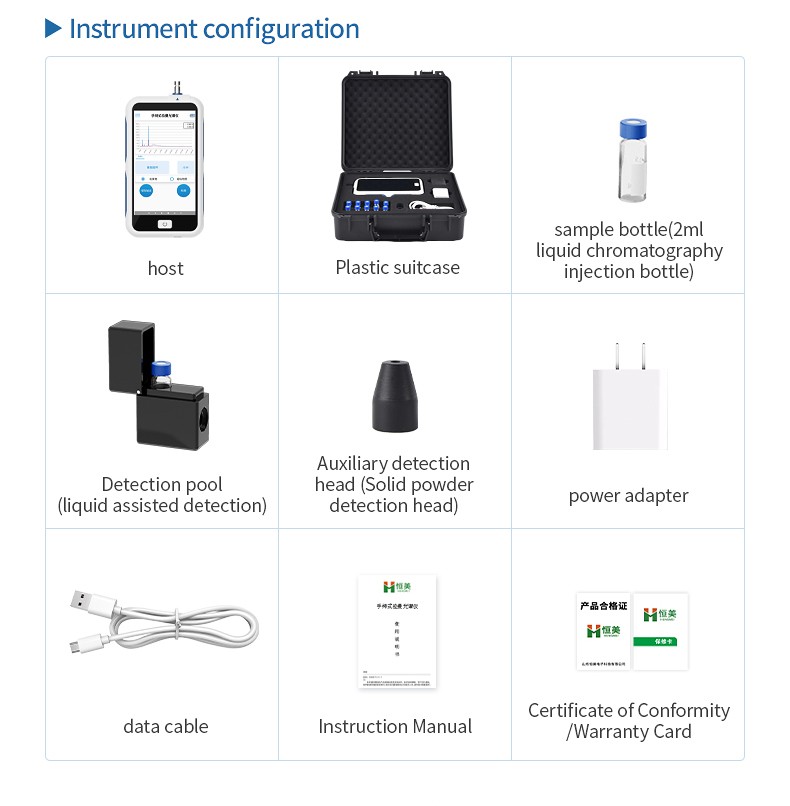
Each HM-SLM is delivered as a complete field kit:
- HM-SLM handheld Raman spectrometer main unit × 1
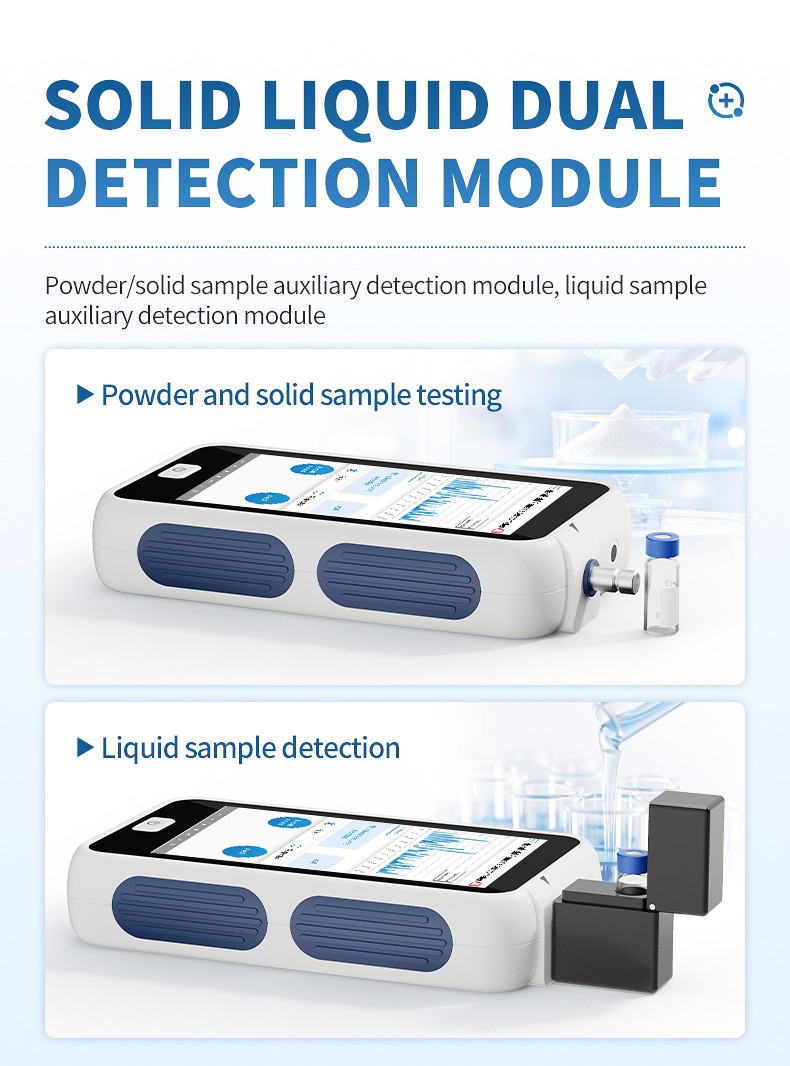
- Solid powder / solid sample auxiliary detection head × 1
- Liquid assisted detection pool × 1
- Sample bottles, 2 ml liquid chromatography injection vials × 10
- Power adapter (5 V / 2 A) × 1
- Type-C data cable × 1
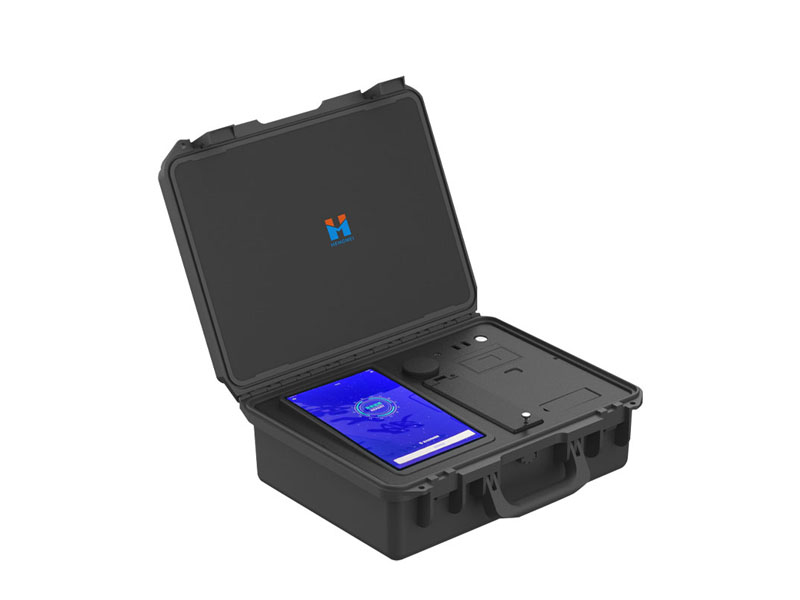
- Plastic carrying case × 1
- Instruction manual × 1, certificate of conformity × 1 and warranty card × 1
Operation and Support
Sample handling differs by material, and choosing the right accessory is the key step:
- Charge with the supplied adapter (about 4 hours) and hold the power button for three seconds to start.
- Solids such as tablets or plastics: fit the probe cap and press its narrow end against the sample surface.
- Powders such as ground material: transfer about 0.5 ml or more into a quartz vial and contact the probe with the top of the powder heap; a heap that is too shallow will let the laser pass through and the test will fail.
- Liquids: use the liquid assisted detection pool with a quartz vial. For dark or flammable samples, start at low laser power, and do not immerse the instrument or accessories in a suspected corrosive or heat-sensitive liquid.
- Review the match, then export a report or save the record; records can be exported via the data cable or uploaded to the platform.
Supporting the workflow: The default matching threshold of 0.92 is normally appropriate and laser intensity is typically set around 80 for routine measurement. If a glass-packaged sample shows strong fluorescence and a weak signal, the glass wall may be too thick and a quartz container should be used. Building site-specific library entries from materials that have already been released by full laboratory testing is the most effective way to reduce failure-to-match rates. The instrument should not be disassembled; contact the supplier for service and keep the warranty card.
FAQ
How does the HM-SLM fit into an incoming inspection workflow?
It provides a rapid, non-destructive identity check at the point of receipt, often through transparent or semi-transparent packaging, so materials can be preliminarily confirmed before full laboratory testing is complete.
What causes a failure to match, and how is it resolved?
Typical causes are laser intensity set too low, a matching threshold set too high, an unselected search scope, or a material not yet in the library. Adding a verified reference spectrum resolves the last case.
Which packaging can be measured through?
Thin transparent plastic and clear glass are usually suitable. Thick amber glass, opaque drums and metallised foil are not; use a quartz container in those cases.
Product Enquiries
Contact our sales representative for product enquiries, configuration information and coordination of service requests.
Sales Contact: Arthur
Email: Arthur@hmdzkj.cn
Tel / WhatsApp / WeChat: +86 18353666151
Article address:https://www.spectrometer.top/pro1/18.html
- Previous: no more
- Next: Raman Spectrometer